Skip to content

The Psychology of Premium
It’s Not Just About Quality – The Hidden Dimensions of Perceived Value

We’ve matched their quality, so why aren’t people paying our price?
You’ve created a product, and you know that it’s good. Not even just good, it’s great. It’s at least as great, if not better, than some of the market leaders in your category. And yet again, you’re struggling to sell.
The competitors that do sell expose an interesting paradox which you can’t make heads or tails of. There are the premium competitors that deliver no more than you do in terms of quality, but manage to charge three times your price, still shifting far more units than you could ever dream of. On the other hand, you’re competing with private labels, which are continuously levelling up to the point that the quality they offer is close to yours, much to the delight of savvier consumers.
You know that you deliver the highest quality – so why are people not buying?
Functional quality is just one ingredient. The real value equation is shaped by emotion, story, context, and subconscious cues. If quality were all that mattered, every consumer would buy the cheapest olive oil that tastes decent. But they don’t. Here’s why.
The Hidden Levers of Value Perception
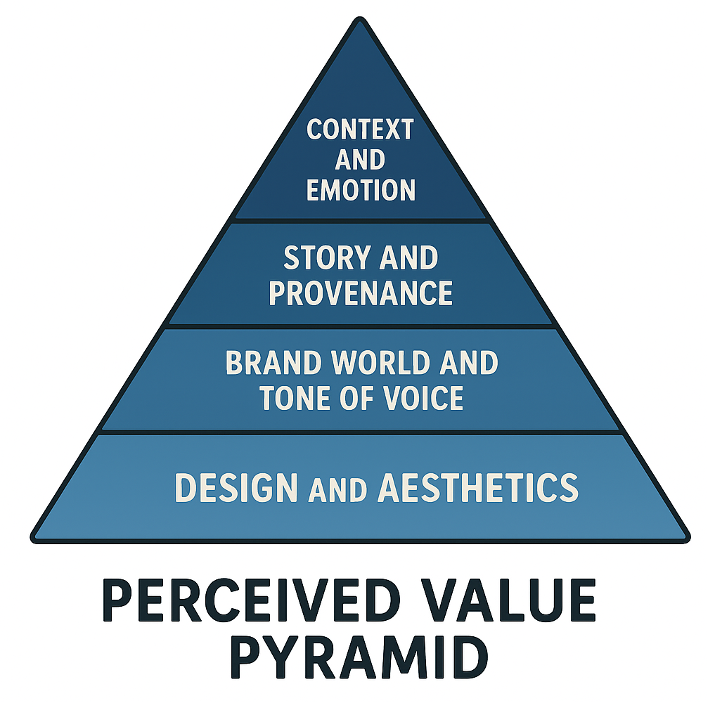
Especially in premium and luxury contexts, there are five key factors outside of pure quality that make consumers believe in the value of a product, whether it’s a box of chocolates or a three week holiday in the Bahamas.
a) Story & Provenance
Where does the product come from, who made it, and how did it come to be? Creating narratives around a product elevates its perceived worth. Sometimes these narratives tie in with the actual origin of what you’re offering, but a lack of heritage does not need to be a barrier either. Hendrick’s is a great example of creating visuals that make you feel that their brand (which, spoiler alert, was only invented in 1999) has been around since Victorian times. This is what makes them different from a supermarket gin – they offer the same ABV, but far different storytelling.
b) Design & Aesthetics
Packaging, colour palettes, typography and tactile finishes – these are all factors which shape expectations before first use, and make us pick up a product before we even fully know what it is. Our brains store memories and perceptions in the form of associative networks, for example linking the colour red with both danger and love. Evolutionary mechanisms, cultural norms and our own personal experiences all help us develop shortcuts to evaluate the world around us, and while some are essential to survival (not eating a neon purple frog, for example, as it’s probably poisonous), others simply tell us that something is advanced (through sleek design features) or premium (e.g. matte finishes).
c) Brand World & Tone of Voice
The ‘feel’ of a brand goes a long way in justifying its products’ value, whether it exudes confidence, exclusivity, humour, or refinement. Producing not just products and services that really resonate, but creating a distinctive identity as well, serves to establish your brand as something special, unique, worth paying more for. Aside from making your brand memorable and top of mind, a well-defined tone builds credibility and perceived worth that goes far beyond function.
d) Context of Use
Is it a Tuesday pasta night or a Friday date night? The same product feels more or less premium depending on the occasion. Because people assign value based on the role the product plays, it is important that you associate your product with the right contexts and occasions. This can be done very successfully through visuals, showing the type of space your product lives in, and the type of person who would use it – which also explains the strength of celebrity partnerships and influencer marketing. You’re not just selling your product, you’re selling the lifestyle that comes with it.
e) Social Cues & Peer Influence
Speaking of influencers: Perceived popularity, social proof, or recommendations from others (whether literal ‘influencers’ or friends and family) can amplify perceived value, even without a change in product quality. We’re social creatures who trust in the opinions of others, and good reviews and enthusiastic endorsements will make us believe in the value of a product or service we haven’t even tried ourselves.

What Brands Often Miss
Brands that develop a superior product can fall into the trap of believing that functional advantages, or even just functional parity with a premium competitor, will automatically lead to a premium perception – if you’ve paid attention so far, you’ll see that much more is needed.
That’s not to say that quality isn’t key – it’s just that it’s the non-negotiable foundation, rather than a true differentiating factor, especially in saturated markets. You may have focused all your development time on creating the best product, but if your brand focuses its communication too much on product attributes and not enough on perceptual assets, you will never get people to buy it.
Another trap brands fall into is to just try and express premiumness through extremely generic cues – think gold finishes, or believing that writing ‘premium’ on the packaging is going to make people pay more. Premiumness is an elusive, diverse and shifting concept, which is expressed differently over time, across different markets, and across different categories. Without understanding what cues your category really relies on (emotionally and contextually), premium efforts will underperform.
But how can you uncover what expression of premiumness is the right one for you?
The Role of Implicit Insight
As said before, premiumness is far more about emotions than it is about facts – that’s why research needs to tap into the underlying, emotional perceptions, rather than reflecting rational evaluations alone. Implicit testing can be a powerful tool in this space, because it reveals what people won’t or can’t articulate – whether a design feels premium, or a story resonates.
Consumer perceptions of premiumness are also not always the same as expert ideas. Time and time again, we’ve tested designs loaded with seemingly premium cues, which were perceived as cheap or irrelevant by the target audience – sometimes less is more, and the most effective cues used sparingly can be far more impactful than throwing the golden kitchen sink at a design or piece of comms.
While many brands focus on proving product quality, what truly differentiates premium offerings often lies beneath conscious awareness. Non-conscious cues – like tone of voice, pack texture, or brand associations – shape how value is felt, not just assessed. By using research that taps into implicit perceptions, brands can uncover why “same quality” doesn’t always mean “same value” in the consumer’s mind – and unlock the levers that justify a higher price point.
So What Is ‘Value’?
Perceived value isn’t just built in the factory—it’s built in the mind. And the mind doesn’t always play fair.
Make sure you rethink your premiumisation strategy through a perceptual lens, rather than focusing on quality alone.
This is the second part of a series exploring premiumisation and its implications for market research. If you’d like to find out more about how Mindlab can help you uncover and the psychology of premium, please get in touch.