 Skip to content

The Shopper Journey Isn’t Linear – So Why Are We Still Treating It That Way?
Inside the Shopper Mind Series (article 1): How People Really Make Purchase Decisions
We like to imagine ourselves as considered, thoughtful shoppers. We picture a clear moment of need (“We’re nearly out of olive oil”), followed by a bit of research, a neat comparison of options, and then a rational, deliberate choice.
But this isn’t how most of us actually shop.
If you’ve ever walked into a supermarket for pasta and walked out with three new snacks, a candle, and the pasta you almost forgot… you already know this. And if you’ve ever opened six tabs of the same product online only to default to the brand you always buy, even when others are cheaper… you also know this.
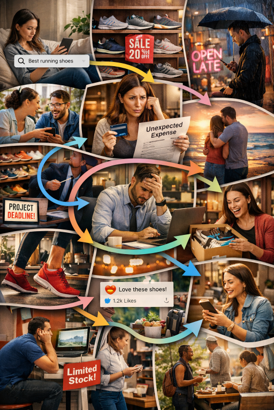
The truth is: the shopper journey is rarely linear. It’s looping, emotional, and heavily influenced by the context we’re in when the decision is made.
Yet most brands still plan and test as if shoppers move neatly from awareness → consideration → evaluation → purchase. A tidy diagram, yes. A reflection of how the mind actually works? Not really.
A World Where Context Rules
What we choose in-store or online depends far less on what we think we prefer and far more on:
- How much time we have
- Our cognitive load
- Our mood
- What feels familiar or comforting
- And whether the choice is “for me” or “for others”
The same person buying the same category will behave differently depending on whether they’re in a rush on a Tuesday evening after work, wandering around the store slowly at the weekend, or shopping online late at night.
These aren’t trivial variations – they fundamentally shift the criteria we use to make our decisions.
Crucially, most of this process happens implicitly, not consciously. Even the most self-aware shopper is influenced by the environment, the mood, and the overall state they happen to find themselves in.
We may tell ourselves we’re comparing price, ingredients, claims or reviews.
But what we feel about the brand – our implicit associations – often determines choice long before we reach the point of conscious justification.
The Messy Middle (And Why It Matters)
Marketers often talk about the “messy middle” – the back-and-forth loop people make between browsing and reassurance-seeking. But the “messiness” isn’t just about having more information than ever. It’s that the brain takes shortcuts wherever it can:
- We default to familiar brands because they feel safer.
- We pick items that stand out visually because the brain likes ease.
- We avoid products that require too much effort to understand.
This is why subtle packaging changes can have disproportionate effects.
It’s not because shoppers are studying the label carefully, but rather because something that once “felt right” suddenly doesn’t.
In order to truly design for the shopper brain, we need to understand how it works.

What’s Actually Driving Shopper Choices
When we look beneath the surface, we see three forces consistently guide shopper behaviour:
1. Habit & Memory
Much of shopping runs on autopilot. Our brains conserve effort by re-choosing what has worked before. This is why brand familiarity is such a strong competitive advantage.
But familiarity can come from many sources – it’s not just about sticking with your branding without changes, but also building on associations people have built over their lives. Building on childhood nostalgia, or drawing from other categories, can be powerful levers to create this feeling.
2. Emotional Comfort
We gravitate towards choices that feel reassuring, safe or rewarding – especially when life feels busy, stressful or uncertain. Small emotional signals (colours, textures, past experiences) influence this more than we realise. Strong design knows these tricks and builds on them, and good research reflects and measures these emotional triggers.
3. Decision Ease
If something is hard to understand, compare or justify, most people won’t bother. Clarity wins. Every time. Clear packaging, recognisable brand cues and fewer steps online are all factors that can help a product be chosen.
None of these factors require conscious thought – and yet they shape the majority of shopper decisions. But how do they compare to traditional models of shopper behaviour?
Why the Traditional “Funnel” Doesn’t Help Us
When classifying brand relationships, we often assume that people neatly move down a funnel, from their first point of consideration all the way to becoming loud advocates of the brand. Similarly, a clean, structured funnel model is often assigned to how people decide what products to buy, whittling down options strategically until the shopper arrives at their final purchase decision.
The funnel assumes that:
- People know what they want
- They evaluate options systematically
- More information leads to better decisions

Reality looks different. Imagine a shopper trying to buy that pasta they came to buy (see, they remembered after all!). They see their familiar brand in the aisle. Then they glance at the competitor promo. They may have a flash of memory, a gut feeling that they may or may not have tried one of those competitors, and didn’t like it. They ultimately pick the original brand – because it “just feels right”.
There’s no conscious comparison matrix at play here, just a quick, emotionally tinted heuristic driving the choice.
In fact, when it comes to deciding what products to buy:
- People often don’t know what they want until they see it
- They evaluate just enough to feel confident
- More information can increase avoidance, hesitation, or default reliance on habit.
Many of the choices happen not linearly, but rather than a space called “the messy middle”. In their decision journey, people end up bouncing between, browsing, considering, reassurance-seeking, and defaulting to short-cuts – and all this bounding happens in mere seconds, and is driven by instinct rather than conscious consideration.
So when brands focus on rational claims, functional superiority, or comparison logic alone, they may actually be optimising for the wrong decision system.
Because the choice that “makes sense” is not always the choice that feels right.
So What Should Brands and Retailers Do?
If we accept that shopper decisions are emotional, fast, and context-shaped, then strategy needs to fundamentally shift, taking into account the following:
- Make your brand instantly recognisable.
Not just identifiable – recognisable in a way that feels familiar. - Design for intuitive clarity.
The shopper should know who the product is for, what it does, and why it matters in under a second. - Respect the decision moment.
Shelf layout, navigation, language, review cues, and digital thumbnails matter because they shape the feeling of confidence and ease.
In other words: If you want to influence behaviour, build on the environment in which behaviour happens. The shopper brain is not the same as the consumer brain, and rather than using store environments to really push your brand narrative first and foremost, you need to pull the levers that drive decisions under pressure.
Next up
In this post, we addressed how shoppers move – fluidly, emotionally, sometimes chaotically.
In the next part of this series, we’ll look at why certain products “feel right” in the moment of choice – the implicit emotional drivers that guide shoppers long before they can explain their decisions.
Because understanding the shopper journey is one thing.
Understanding what shapes it is where the real opportunity lies.
If you’re reviewing packaging, online product pages, or in-store messaging this quarter, now is a perfect moment to question whether they’re built for real shopper decision-making. Get in touch to find out more about how implicit research can help.


